Marie Burgess Brown of New York City's Glad Tidings Tabernacle
A Model of Female Pentecostal Authority
Marie Burgess Brown is best read not as an exception to male-led ministry but as an early template for how Pentecostalism itself authorized women to lead. Her authority rested on several pillars at once, and it is the combination — not any single credential — that made it durable for over five decades.
Charismatic call. Like the other founding mothers of the movement, her authority began at Azusa Street, in a personal Spirit baptism she claimed required no further human ordination to validate it. The call itself was the credential.
Institutional co-founding. Unlike itinerant evangelists who depended on rented halls and revival tents, Marie and her husband Robert A. Brown planted and jointly pastored Glad Tidings Tabernacle in Manhattan — giving her a settled pulpit and denominational standing inside the Assemblies of God rather than a platform outside it.
Marital partnership rather than subordination. The Browns preached as co-pastors, not as a minister and his helpmeet. That co-equal framing let her exercise pulpit and administrative authority without having to found an independent movement of her own, as Aimee Semple McPherson did in Los Angeles.
Mediated reach. Radio broadcasting in the 1940s extended her voice into homes across the city and, through syndication, well beyond it — a mass-audience authority that did not depend on being physically present or denominationally credentialed in every market she reached.
Mentorship and succession. Glad Tidings functioned as a training ground for missionaries and pastors who carried her model forward, so her authority persisted institutionally after her own preaching ministry ended.
Set beside McPherson's independent, celebrity-driven model, Brown's is the quieter, denominationally-embedded alternative: authority built through partnership and institution rather than through founding a new one. Both patterns answer the same question — how did early Pentecostalism, which preached that the Spirit falls on "sons and daughters" alike, actually make room for women to lead? — and both remain live models for how women exercise pastoral authority in Pentecostal and charismatic circles today.
Listen: Audio Testimony
Marie Burgess Brown, a Pentecostal woman preacher like Aimee Semple McPherson in Los Angeles, speaking in the 40s NYC Mega Church on radio in the era of WW2.
Glad Tidings Tabernacle & a New Creation for Muslims
When my publisher Ralph Winter and my editor Donald McGavran returned from speaking at the historic 1974 Lausanne Conference, Dr. Winter told me he wanted a book for Muslims like the one he had published for the Jews, Everything You Need to Grow a Messianic Synagogue. For the first draft I assembled in New York City not only David Irwin, who was about to found the Springfield, Missouri, Global Initiative: Reaching Muslim Peoples, but also a few other Muslim missionaries to help me assemble what would become The New Creation Book for Muslims.
David Irwin spent decades dedicated to ministry in the Muslim world, beginning with formative years in Egypt alongside Lillian Trasher at the famed Lillian Trasher Orphanage in Asyut. Working in that environment gave him firsthand immersion in Egyptian culture, Arabic, and day-to-day life among both Coptic believers and the surrounding Muslim majority, helping shape his lifelong burden for the Islamic world.
Life and Ministry
Egypt and the Middle East. Irwin's early service in Egypt, connected directly to Lillian Trasher's compassionate outreach, cemented a posture of tangible service and deep personal care rather than adversarial debate.
Global Initiative: Reaching Muslim Peoples. Stationed out of Springfield, Missouri, with Assemblies of God World Missions (AGWM), Irwin was central to the founding and long-term direction of the Center for Ministry to Muslims (CMM), which grew into Global Initiative: Reaching Muslim Peoples. Under his leadership, the initiative focused on:
mobilizing prayer for the Muslim world, including specialized prayer guides during Ramadan;
training and equipping cross-cultural workers with culturally nuanced, respectful approaches to sharing the Gospel;
producing contextualized literature and resources to help Western churches understand and love their Muslim neighbors.
Advocacy and mentorship. For years in Springfield, Irwin served as a mentor to young missionaries heading into North Africa, the Middle East, and South Asia, emphasizing patience, deep relational investment, and persistent prayer.
The Tragic Accident
I took David's rough draft and combined it with the writing of the other Muslim missionaries. Then I turned it into Quranic-style poetry. I was almost finished when, one day, David called me from Springfield. I could tell he had been weeping. I could also tell he was in the Spirit.
He said, “Phil, we have to finish the book now.”
I said, “David, I don't have much left to do, but it has to be translated into Arabic.”
He said, “No, Phil, there is no time. Look, I have some friends at Editorial Vita in Miami. I will get on a plane and fly to New York and pick you up and we will go to Miami together and they will publish it.”
There was a long pause. How could I tell him that was not possible?
Finally, he said, “It's all right, Phil. Don't get under bondage.”
A very few days later, he was sitting in his car at an intersection and another car hit him and killed him instantly. Then I knew why he called me; he had a Pentecostal word of knowledge and knew time had run out. Indeed, time is running out for Western churches to wake up to what is happening around them. Glad Tidings Tabernacle, a megachurch of the 40s, closed its doors near Penn Station and was demolished. Meanwhile, New York City has a Muslim mayor and a new, large, imposing mosque—the Islamic Cultural Center of New York—has been built in Manhattan. Outside where Glad Tidings Tabernacle once stood, now the property of a Mormon-owned hotel, women in burkas pass by and the one out of four people in the world who are Muslims seem to be everywhere in New York City.
David Irwin's sudden death was a massive loss to the Assemblies of God missionary community and to the global network of workers he had spent decades encouraging and training.
His legacy continues through Global Initiative, which remains headquartered in Springfield and continues the research, prayer mobilization, and worker-training models he helped establish.
The Islamization of the West
“Islam is not only shaping the East; it is increasingly shaping the West, and the Church must awaken to this reality.”
— Global Initiative: Reaching Muslim Peoples (Assemblies of God World Missions)
The Lubavitcherization of the Messianic Great Commission
A comparison of Chabad-Lubavitch’s worldwide emissary network with Great Commission missionary architecture—and of the striking messianic parallels that emerge from that comparison.
“There certainly are Messianic congregations that do have good outreach and proclamation to the lost, but for too many others, evangelism does not have a high priority.” This is a quote from Moshe Rosen in a Caspari Mishkan 2005 article. Meanwhile we see Lubavitcher emissaries aggressively speaking to people on the street as they are sent all over the world to do street outreach and establish Chabad houses. And if there are any Jews or non-Jews the Chabadniks can't win, the JWs will be right there on the street to get them and the LDS missionaries will also soon be knocking on their door.
There is a striking Great Commission structure to modern Chabad outreach, and in the case of Chabad messianism there are scholars who explicitly describe particular beliefs as remarkably close to these very categories. What is especially interesting is that the parallels are not merely superficial.
The Chabad phenomenon: a so-called "Jewish counter-mission"
Rabbi Menachem Mendel Schneerson transformed Chabad-Lubavitch from a relatively small Hasidic movement into a worldwide Jewish outreach network. His shluchim—literally “emissaries”—were dispatched to cities and remote locations around the world to establish Jewish life. Chabad itself describes the shlichus project as sending couples to places where they would establish a Chabad House, teach Torah, strengthen Jewish identity, and serve Jews in every possible way. Today Chabad reports more than 6,000 families of emissaries in more than 100 countries.
That makes the comparison with Great Commission missionary expansion immediately recognizable:
Great Commission missionary pattern
Chabad-Lubavitch pattern
Missionary
Shaliach / emissary
Mission
Shlichus
Church
Chabad House
Gospel proclamation
Torah / mitzvah outreach
Missionary headquarters
770 Eastern Parkway
Missionary network
Worldwide shluchim
“Go into all the world”
Reach every Jew
Evangelize the nations / Jew first
Intensively reach Jews first
New Testament / Great Commission activity and teaching
Torah, Chabad teachings, Igrot Kodesh and Rebbe's writings
Missionary supported by sending constituency
Local Chabad operation supported by its community
Evangelist represents risen Messiah
Shaliach represents the Rebbe
And the resemblance is not merely something others have invented.
Chabad itself uses remarkably missionary vocabulary. It explicitly translates shlichus as “mission,” “agency,” or “task,” and describes the Rebbe's emissaries as people dispatched to particular territories to carry out that shlichus mission.
The difference, of course, is fundamental: Chabad is not trying to introduce Jews to a living Redeemer; it is trying to bring Jews back under Torah and mitzvot. But is this Judaism? And is this really a Jewish counter-mission and Yiddishkait?
Doesn't Scripture say that the Torah brings wrath and exposes sin and cannot bring life? Is Chabad really preaching the true Judaism of the Bible by bringing Jews to see Torah and mitzvos as the elixir of Yeshuas Elokeinu? And aren't they running into a dead end, just as with the vain attempt to make a living redeemer out of a dead and buried rabbi without bodily resurrection? Let's answer that question with a chain of several texts.
The Torah Exposes Sin
“Through the law comes knowledge of sin.” — Romans 3:20
“I would not have known sin except through the law.” — Romans 7
“I would not have known what it is to covet if the law had not said, ‘You shall not covet.’” — Romans 7:7
So Torah functions as a revelation of God's standard . It puts sin into the light and identifies transgression for what it is.
“The law brings wrath.” — Romans 4:15
“The Law came in so that the offense would increase.” — Romans 5:20
That doesn't mean, of course, that Torah is bad.
“The law is holy, and the commandment is holy, righteous and good.”
The problem is what happens when a holy commandment encounters sinful humanity.
The Torah Cannot Impart Life
.
“For if a law had been given that could give life, then righteousness would indeed be by the law.” Galatians 3:21
If Torah were capable of imparting the life necessary for righteousness, then Torah would itself be the means of justification. But it isn't.
Instead, Scripture has confined everything under sin so that the promise might be received through faith in a living resurrected Messiah.
But Chabad extolls the law that cannot impart life and lifts up the praises of a dead Rabbi. Is this the Judaism of the Bible?
Scripture makes the distinction between Torah and the life-giving Spirit, the Ruach Hakodesh
.
Scripture contrasts:
the letter → kills
the Spirit → gives life
the ministry engraved in letters on stone → a ministry of death
the ministry of the Spirit → a ministry of righteousness 2 Corinthians 3:6-9
God's Torah is of course not morally bad. Indeed, Romans 7 explicitly prevents that interpretation. Rather, the written commandment cannot itself generate the new life necessary to fulfill God's will, a deficit for which Jeremiah prophesied the remedy of the Brit Chadasha with the Rev 3:20 new life Word and will written on the heart. Jeremiah 31:31-34
The Sinful Passions Aroused By the Law Produce Fruit for Death Romans 7:5
So the Scriptural progression is:
Torah → defines God's righteousness → exposes sin → makes transgression unmistakable → brings condemnation/wrath upon transgression → cannot itself impart resurrection life.
And therefore something beyond Torah is required.
Now we apply this to the Chabad claim
This is where the argument can be made quite sharply without saying, of course, that Torah itself is bad.
Chabad's own published material describes Torah and mitzvot as central to redemption. Chabad's presentation of Rambam says that the Messianic age will be an era in which Jews fulfill all the mitzvot and that the essential Messianic goal is the complete fulfillment of Torah and mitzvot.
Chabad also explicitly uses the language of Torah as an “elixir of life.” One Chabad exposition cites the rabbinic teaching that Torah can be an *elixir of life* for the worthy and poison for one who is not worthy.
And another Chabad exposition describes mitzvot themselves as signifying life and says that observing them attaches a person to God, the Source of Life.
The Scriptural counterargument would be:
The Torah can tell the dead man what life looks like; it cannot raise the dead man.
It can say:
“You shall not covet.”
But it cannot remove the power of covetousness.
It can define righteousness.
But it cannot make the unrighteous righteous.
It can identify death.
But it cannot itself conquer death.
The Scripture's language in Romans 7 is almost painfully exact:
“When the commandment came, sin came alive, and I died.”
Thus, if Torah and mitzvot themselves become the mechanism by which one expects to obtain *yeshuat Eloheinu *—God's salvation—the Scriptural argument is that the means has been confused with the goal.
And this brings us to the resurrection argument
This is where two arguments can be joined into one much larger apologetic argument .
Accept no substitutes if you want the real Judaism of Scripture! There are actually two different substitutes for resurrection :
Substitute #1: Torah observance instead of resurrection life
The proposal becomes, in effect:
Sin → Torah → mitzvot → spiritual improvement → redemption.
The answer of Scripture is:
Sin → Torah exposes it → condemnation → Messiah → death and resurrection → Spirit → new life.
The issue isn't whether mitzvot are good. Scripture would agree that God's commandments are holy and good.
The issue is where the life comes from .
Scripture says it comes through Messiah and the Spirit, not from the commandment itself.
Substitute #2: A dead teacher instead of a risen Messiah
Chabad itself does not deny resurrection as a doctrine. In fact, Chabad has extensive teaching concerning Techiyas HaMesim, the resurrection of the dead. One Chabad text describes resurrection as a distinct future era following the Messianic era.
The issue is:
“A deceased human Messiah cannot function as the Scriptural Messiah unless death itself has been conquered in that Messiah.”
The Scriptural claim is radically different from Chabad:
The Messiah does not merely tell humanity how to live.
The Messiah gives humanity His own resurrection life.
That is why the Scriptural argument in Romans 7 moves directly toward Romans 8.
Romans 7 ends with:
“Who will deliver me from this body of death? (When the commandment entered, I died.)”
And the answer is not:
“More Torah.”
It is:
“Thanks be to Hashem through Moshiach Yeshua Adoneinu!”
And Romans 8 immediately turns to “the Spirit of life” and ultimately to resurrection.
And there is an especially powerful Scriptural truth: Torah reveals sin; Moshiach deals with sin.
“If a law had been given that could give life, then righteousness would indeed be by the law.” — Galatians 3:21.
That is the dead-end argument in its most compact biblical form.
The issue of a dead Messiah should be put precisely where Scripture puts it:
“If Moshiach has not been raised, your faith is futile; you are still in your sins.” — 1 Corinthians 15:17.
And that is a very different kind of claim from saying that a revered rabbi's teachings continue to produce spiritual effects.
The Great Commission proclamation is not merely “follow the Messiah's Torah.”
It is:
The Messiah died.
The Messiah was buried.
The Messiah was bodily raised.
Therefore the Messiah Himself is alive.
And because He lives, He can give life.
That last step is precisely what a system centered upon commandment, observance, or the continuing influence of a deceased teacher cannot reproduce on its own. This is pseudo-Judaism.
There was once a great deal of wishful thinking about something called the Maginot Line. It might help to relate that to the wishful thinking going on about Rebbe Schneerson being the Messiah. But first, the Maginot Line.
There's a generation now that probably doesn't know anything about the Maginot Line. But this is very important, because the Maginot Line is a monument to human certainty. The nation of France built the Maginot Line because it needed safety to be true. It had a psychological need, and therefore it declared that its national safety was actually true.
Billions of francs were thrown into this: miles of concrete bunkers and artillery. There was a great national sigh of relief because the trauma of World War I would not be repeated. There was just this glorious feeling—not wishful thinking, although that is what it was, but the belief that it had to be true simply because they declared it to be so. And then what happened? The Germans simply walked around it.
So the Maginot Line is not just a fortification; it's a psychological artifact, a monument to the human ability to confuse desire with reality. You know, I may desire the tomb of Moshiach Ben Dovid to be empty, but that doesn't make it empty, does it? Just because I desire it? However, in the case of the empty tomb of Moshiach Ben Dovid, this is an evidence-stacked case.
Jerusalem was the worst possible place to preach a bodily resurrection unless the tomb was actually empty. They weren't being wishful thinkers when they started preaching the resurrection. The earliest proclamation, "God raised him from the dead," was made in Jerusalem—the very city where He had been executed and buried. If the body were still in the tomb, the authorities or opponents would have publicly refuted the resurrection claim simply by producing the corpse.
And, of course, these men were going to be in severe trouble for preaching this message. It was sort of like having a Bible in North Korea, where you will immediately be arrested, tortured, and killed just because you possess it. These men would have been crazy to make something like that up. The earliest witnesses were also women—an unlikely invention, because women did not have legal credibility in the courts of that era. In fact, their testimony was widely regarded as less legally reliable. In the early movement, if they were merely inventing a story, they would have chosen male witnesses, ideally cohanim or respected elders; they would not have independently chosen women of all people.
The empty tomb tradition is also extremely early. We find it in the pre-Pauline formula in 1 Corinthians 15, and we find it in the Mark passion source. These sources reflect material circulating within the earliest days following the death of Moshiach, Yeshua HaMashiach—far too early for legendary development. It is the earliest strata of the movement. And where do we find the empty tomb narrative? Right there.
Consider Jewish burial customs. You can't simply climb out of wrapped tachrichim soaked in spices; it would be like trying to escape a mummy's bindings. You can't do it. Even the polemics of opponents presuppose an empty tomb. That's where they came up with the farfetched notion that His disciples stole the body. Why would they steal the body and then preach an empty tomb when it was going to get them killed? They had no vested interest in circulating something they knew was false.
The rise of the resurrection faith is inexplicable without an empty tomb. We know the tomb was empty; there is no question about it. We have independent attestations, extra-biblical material, and even archaeological corroboration regarding Pontius Pilate. You cannot reasonably postulate that this is just a myth. The Messianic Jewish framing—k'vi'at gufat haMashiach—is right there. You can look at the Orthodox Jewish Bible and verify this.
On the other hand, if anybody today preaches that someone is Moshiach Ben Dovid while their body remains in the tomb, there is a big problem in trying to believe that. It looks like wishful thinking if there ever was such a thing.
When the French built the Maginot Line, spending billions of francs on miles of concrete and artillery, they felt a psychological euphoria. They needed safety to be true, and they thought, "We are now safe; World War I can't be repeated." They were saying, in effect, "Peace, peace," when there was no peace (as Jeremiah put it). In other words, there was massive wishful thinking. There is no savior in a grave; there is no redemption; there is only a burial. You cannot put a crown on a corpse. Nobody conducts a coronation for a corpse. You are not going to pull a corpse out of a tomb where it has been buried six feet under, drag it into a throne room, place it on a throne, and put a crown on it. Can you imagine the odor of putrefaction? There is a way that appears right, but it's only wishful thinking—as Proverbs teaches.
Every generation builds its own Maginot Lines. You can place a crown on an idea, but that does not give it breath. A proclamation is not a resurrection. You can enthrone a memory, but you cannot make it rain. The Maginot Line teaches us that sincerity is not the same as truth, and wanting something does not make it so. This generation needs to understand why France built the Maginot Line: World War I had traumatized the nation, and they wanted certainty. They wanted something that guaranteed safety and thought Germany could never invade again. They built a wall that made them feel safe, but feeling is not reality. Germany simply bypassed it through Belgium—a route the wall didn't cover—and France fell in six weeks.
The Maginot Line is an emblem of false security, believing your own PR, and getting caught up in fantasy. I thank God that what we believe is not fantasy. I thank God for the הַבִּיאָה הַשְּׁנִיָּה
HaBi’ah HaShniyah “The Second Coming”. Hallelujah! I thank God that there is a Second Coming, and I thank God we can know the tomb of Moshiach Ben Dovid is empty.
We can also know our tombs will be empty, because to be absent from the body is to be present with the Lord. As far as our body is concerned, at the last trump there will be the הַבִּיאָה הַשְּׁנִיָּה
HaBi’ah HaShniyah “The Second Coming”. Hallelujah! That is where our bodies exit the tomb. This is a glorious truth to understand. It took years for it to fully sink into my own life.
Bi’ah *Beit-Yod-Alef-Heh* and *Shin-Nun-Yod-Yod-Heh* (*Shniya*)—that is how you say "Second Coming" in Hebrew.
At the resurrection, the Lord descends from heaven and the dead in Moshiach rise first. This is the emptying of the tombs. His tomb is already empty; my tomb will be empty; the body will not remain there. The living who remain will be caught up together with Him in the clouds, but they will not precede those who have already died. Yes, there will be a great falling away; yes, there will be the man of lawlessness; yes, the anti-Moshiach will appear. But to be absent from the body is to be present with the Lord. My spirit will be immediately present with Him. That is why I desire to depart and be with Moshiach, which is far better: immediate fellowship with Ben Dovid. When I close my eyes in death, I will see Him. I don't merely hope to see Him; I know His tomb is empty.
As for my body, it will be raised immortal at the הַבִּיאָה הַשְּׁנִיָּה the *Bi'ah HaShniya*. Hallelujah! This corruptible will put on incorruption, and this mortal will put on immortality. Look, I already have my burial plot purchased, and it has my name on it. When my body goes in there, it will be sown in corruption, but it will be raised in incorruption. It is sown in dishonor, raised in glory; sown in weakness, raised in power; sown a natural body, raised a spiritual body. It is like a seed placed in the ground that undergoes a metamorphosis—just like my spirit became alive when I was born again.
My mother told me for years to read the Scriptures, and I refused. Why? Because I was spiritually dead. You cannot get a stillborn baby to cry and crave the pure milk of the Word of God; it is dead. I could not crave it. But when I became a newborn babe, I started craving and crying for that pure milk. It took years of prayer and preaching for me to arrive at that point. When I did, not only did I come to love the Scriptures, but I reached the point where I could translate them into other languages for others.
We completed a Yiddish translation. We dusted off Mordecai Bergmann's Tanakh and Yehoyesh's Brit Chadasha in Yiddish, updating the orthography and vocabulary. But when I was dead in my trespasses and sins, my mother couldn't even convince me to open the Bible. All of her prompting and pleading seemed in vain. Yet in an obstetrics delivery room, there is that hush of quiet, followed by a cry—a little cry, or sometimes not so little. It is a newborn child crying for milk. Once I became a newborn babe spiritually, I cried for the milk of the Word.
We shall not all sleep, but we shall all be changed in a moment, in the twinkling of an eye, at the last trump. Yes, it is appointed unto men once to die, and after this the judgment. But I am speaking of people whose judgment Moshiach took upon Himself. There is therefore now no condemnation. They leave this world alive in the spirit, and their spirit is immediately with Moshiach—a friend closer than a brother. When you close your eyes in death, the first person you see is Him: your Savior, the Lamb whose blood delivers you out of bondage.
Then, at the הַבִּיאָה הַשְּׁנִיָּה Second Coming (*Bi'ah HaShniya*), your body will come out of the grave renewed, changed in the twinkling of an eye, given a resurrection body like the one He modeled in the Upper Room. The Apostles were martyred; almost all of them sealed their testimony with their blood, confirming not only that the tomb was empty, but that they saw its occupant and touched His wounds. If the Spirit of Him that raised up Moshiach Ben Dovid from the dead dwells in you, He will also quicken your mortal bodies.
Right now, in the physical body, we are absent from the visible presence of the Lord. At death, our spirit is present with Him while the body rests in the grave. At the הַבִּיאָה הַשְּׁנִיָּה the *Bi'ah HaShniya*, the body will be raised immortal and reunited with the spirit, to be with the Lord bodily forever. This is not wishful thinking; this is established truth. We groan to be clothed with our resurrection body. We will not be disembodied spirits, because full redemption includes the body—the *Techiyas HaMeisim*, the resurrection of the dead, a core doctrine of biblical faith.
Where is this doctrine found in the Brit Chadasha? In Matthew 24, we see the Bar Enosh coming on the clouds of heaven. In Matthew 26, Moshiach Ben Dovid testifies before the Sanhedrin: "You will see the Bar Enosh sitting at the right hand of Power, and coming on the clouds of heaven." In Mark 13, He comes in the clouds with great power and glory. In Luke 21: "Then shall they see the Bar Enosh coming in a cloud with power and great glory." In John 14: "If I go and prepare a place for you, I will come again." In Acts 1: "This same Yeshua, who was taken up from you into heaven, will so come in like manner as you saw Him go into heaven."
You find this doctrine repeated in 1 Thessalonians 4, 2 Thessalonians 1, 1 Corinthians 15, 1 Timothy 6, Titus 2 ("the glorious appearing"), and Hebrews 9:28 ("He will appear a second time"). James 5 urges: "Be patient therefore, brethren, until the coming of the Lord." First Peter 1 speaks of the revelation of Moshiach, 2 Peter 3 refers to the Day of the Lord, 1 John 3 says "when He appears," Jude 14 speaks of the Lord coming with ten thousands of His saints, and Revelation 1 and 19 describe His triumphant return.
I know that my Redeemer lives, and that He shall stand at the latter day upon the earth (Job 19:25). You cannot produce His body because He arose. He is the *Dvar Hashem*—by the Word of the Lord the heavens were made. He is the Proverbs 30:4 Son who created the stars, the Word of God, Adoneinu and Moreinu. He vacated His tomb; it is empty right now.
Put two and two together: if our graves will give up their dead, and His tomb is already empty, we must be reconciled to Him. You don't need to pin your eternity on someone who remains in their grave. If He is not in His tomb, it means He is seated in His judicial chamber. The Judge of all (*Shofet HaKol*) has taken His seat. When the court is called to order, the whole world will stand at the general resurrection. Those outside His redemption will stand before the Great White Throne to face judgment. Seek the Lord while He may be found; call upon Him while He is near.
There is only one *Rebbe Melech HaMoshiach*, and His tomb is empty. God raised Him from the dead, He was seen by many witnesses, He ascended into glory, and He is coming again in glory. He is the Bar Enosh of Daniel 7, whom Rashi identifies with the Messiah. You need to be right with the One whose tomb is empty. Every knee will bow and every tongue confess that He is Lord. Moshiach came, He rose from the dead, and the Tanakh is vindicated. Do not trade that for man-made wishful thinking.
Lord, I pray right now that someone's eyes will be opened to turn from wishful thinking. Let them not be like the French builders who believed the Maginot Line would protect them from destruction, only for the invading army to sweep past it through Belgium while Paris fell. Pride goes before destruction. Paris trusted in a wall of wishful thinking; do not let us trust in false messiahs. It is time to seek the Lord while He may be found, and call upon Him while He is near.
Chabad messianism developed Jewish theological categories which, in certain forms, converged extraordinarily closely with categories that Messianic faith had made central.
And some Jewish scholars themselves have been startled by that convergence.
“Lubavitcherization” of the Great Commission?
What is laid out here may be genuinely useful—but as an analytical concept, not as an established academic label.
“Lubavitcherization of Great Commission world outreach” may not be a recognized scholarly term. But the phenomenon is worth naming.
The remarkable thing about Chabad is that it created a decentralized, globally replicated, intensely personal religious-outreach architecture:
central charismatic leader → emissary → permanent local outpost → hospitality → relationship → education → identity formation → replication.
The emissary does not merely preach and leave. He moves there.
The Chabad House becomes simultaneously:
residence,
synagogue,
classroom,
community center,
hospitality center,
information center,
recruiting/outreach base,
and local embassy of the movement.
Chabad explicitly describes the shaliach as a representative of the Rebbe and even says that the emissary's identity is shaped around becoming an extension of the sender's mission. (Lubavitch.com)
That is a remarkably powerful missionary technology.
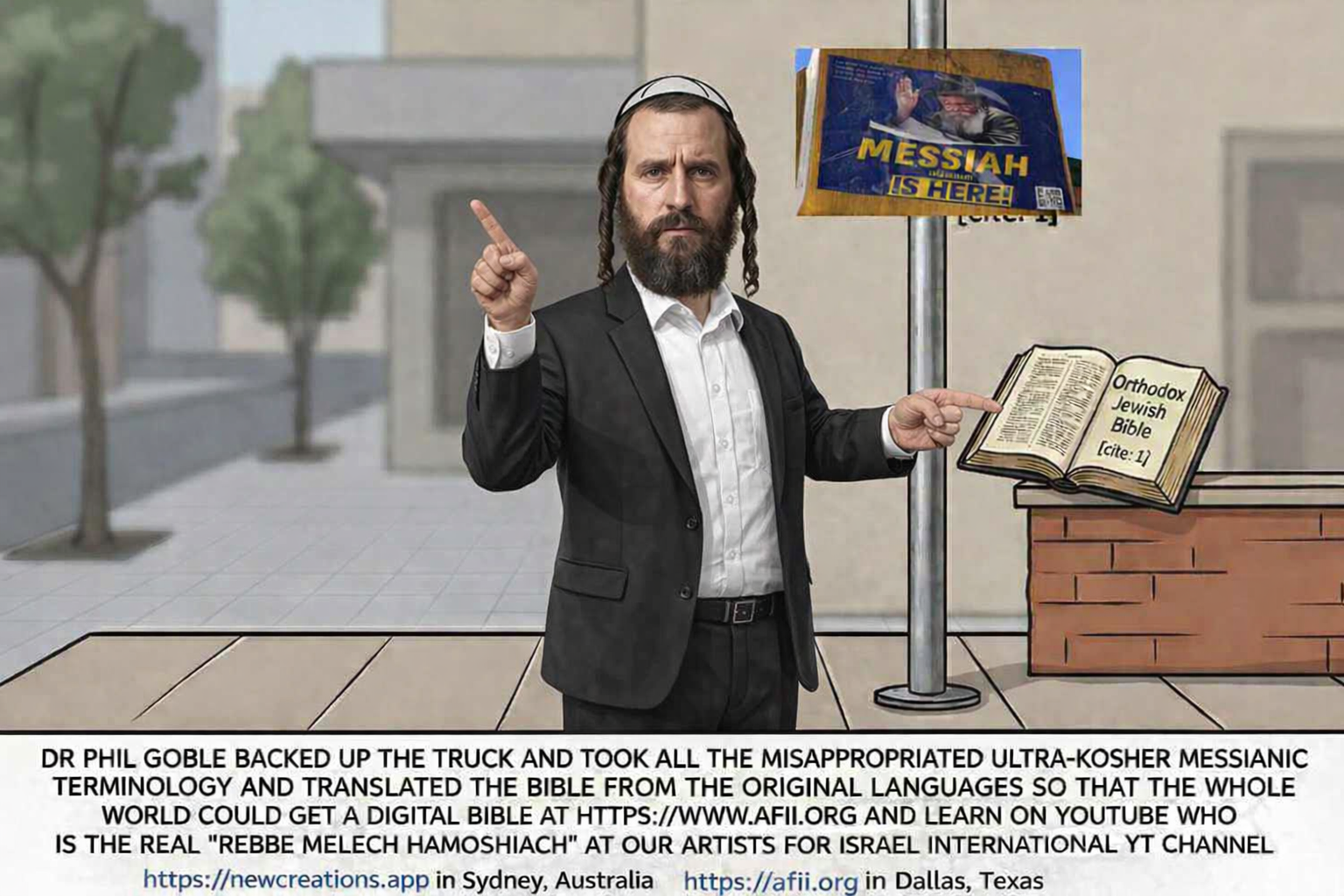
And it may actually be more useful to describe the phenomenon as the Chabadization of Jewish outreach. Chabad took something that believers had been doing globally for centuries—permanent outposts, missionaries, literature, personal evangelism, institutional replication, international conferences—and re-engineered it within an Orthodox Jewish theological framework. But in the activity laying the foundation for the first American applied linguistic Bible translation school, the New Testament harvested all the Chabadnik ultra-kosher Messianic terminology and said, in effect, no it is the Scripture which is the Orthdox Jewish framework, calling it The Orthodox Jewish Bible.
Then there is the fascinating irony:
Scripture says, “Go to the Jew first.” (Romans 1:16)
Chabad says, in effect:
“We will go to every Jew first.”
The Scriptural phrase which colored the execution of the Great Commission in the book of Acts and in Romans 1:16 —“to the Jew first”—belongs to a missionary theology in which the Jewish people have a distinctive historical priority within the Gospel's worldwide expansion.
Chabad reverses the missionary direction. It does not send Jewish emissaries outward primarily to convert Gentiles. It sends them outward to find the Jews scattered among the Gentiles.
Thus the worldwide Chabad map can almost be read as a mirror image of the Scriptural Mt 28:19-20 Great Commission map:
Chabad mission: Brooklyn → Jewish diaspora → every city containing Jews.
And the striking result is that the Jewish people become the mission field without ceasing to be the covenant people. That is perhaps the most important distinction.
Freely streamed on YouTube and afii.org, the film now sits beside AFII’s translation catalog — and beside the training work described below.
Who Is the Founder of This Assemblies of God Applied Linguistics School for Bible Translators?
They asked the same kind of question when they saw the theatre filled with 1,000 Jewish people, the cameras, and the film production for The Rabbi From Tarsus. When people came up to the set on the day of filming in 1986, they looked around in amazement and asked, “Who is producing this movie production?” I said, “Well I know it is CERTAINLY not a homeless washed up guy with 23 cents in the Wishing Well Motel. Let me give you a hint who the Mover and Shaker really is. He is Jewish and He was born in Bethlehem. Now guess his Name.”
From Media Bible to an Assemblies of God School for Translators
The Rabbi From Tarsus was never only a film. It was the first proof, worked out in dollars and film stock and a motel room prayer, of a pattern that has since repeated itself across AFII’s work: a text is given, a form is found for it, and the form travels farther than the person who made it ever could alone. The stage play became a screenplay; the screenplay became a film; the film became, in time, a doorway to other media Bibles, audio and video Bibles, Bible translations, and online Bible platforms like the Bible Society in Israel in Jerusalem and cutting edge Bible translation access technology.
Forty years on, the same instinct that put Sha’ul on film now puts the Yiddish Bible in the palm of a hand.