And what does the British Expositor Adam Clarke have to do with A/G U.S. Missions and the Assemblies of God in general and an A/G Jewish U.S. missionary named Abe Schneider in particular?
Now we have to go back to the 19th century and have a look at Adam Clarke. Adam Clarke (c. 1760/1762–1832) was an Irish-born British Wesleyan Methodist preacher, theologian, biblical scholar, and polymath. He became a Methodist in 1778 and was sent into Methodist ministry by John Wesley in 1782. He eventually became one of the most prominent intellectual figures in early British Methodism and was elected president of the Wesleyan Methodist Conference three times.
His importance is not merely that he wrote a popular commentary. He was an unusually serious Oriental-language scholar for his era, studying Hebrew and other Semitic and Middle Eastern languages. He was involved with Bible Society work, possessed Arabic, Persian, and Syriac manuscripts, and was elected to learned societies.
His great work was his Commentary on the Holy Bible, produced over roughly forty years. It became one of the standard biblical commentaries of nineteenth-century Methodism and remained influential far beyond Methodism.
That background matters here because Clarke was not simply a popular preacher making a casual end-times prediction. He was a major early-nineteenth-century biblical commentator working within the prophetic interpretive traditions of his time.
The Passage in Mind: Daniel 8:14
Daniel 8 contains the vision of the ram and the he-goat. The angel identifies the he-goat as Greece and its great horn as its first king:
“The rough goat is the king of Grecia: and the great horn that is between his eyes is the first king.”
— Daniel 8:21
Clarke identifies that first king as Alexander the Great.
Then comes the extraordinary verse:
“Unto two thousand and three hundred days; then shall the sanctuary be cleansed.”
— Daniel 8:14
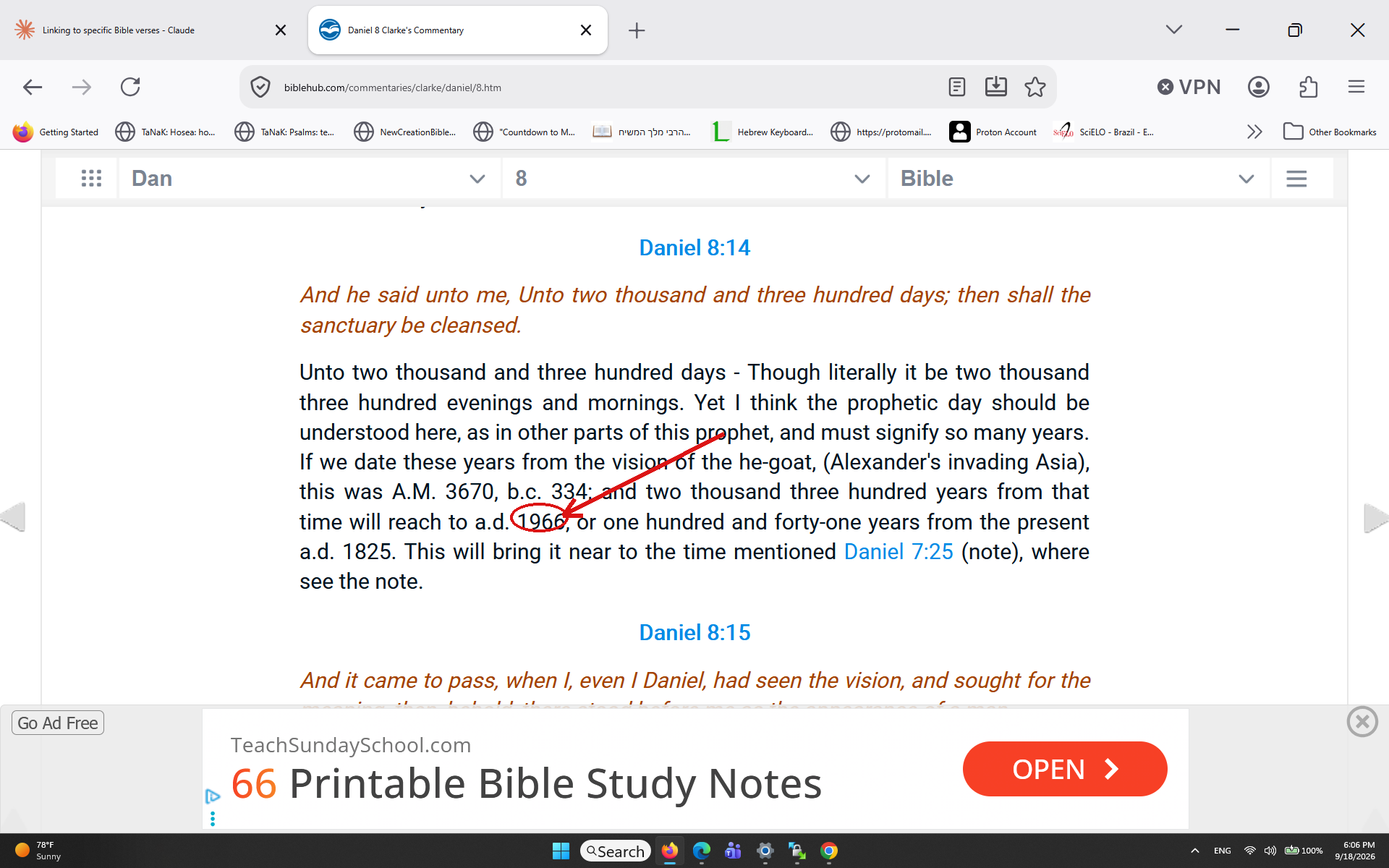
Clarke does something very consequential with those “2,300 days.” He adopts the prophetic day = year principle. And then he explicitly tells us where he starts the clock. Here is Clarke’s crucial statement:
“If we date these years from the vision of the he-goat, (Alexander’s invading Asia), this was A.M. 3670, b.c. 334; and two thousand three hundred years from that time will reach to a.d. 1966…”
Magnificent! He forgot to add 1 because there is no year ZERO at the transition from B.C.E to C.E. but, nevertheless, this is astounding! Did you see what he wrote back when Abe Lincoln was a teenager? 1966! And the Six Day War came in 1967! So Clarke’s calculation is:
- Terminus a quo: 334 B.C. — Alexander’s invasion of Asia
- Prophetic period: 2,300 years
- Clarke’s terminus ad quem: A.D. 1966
And Clarke wrote this while living in A.D. 1825, so this wasn’t hindsight. Scroll down to his commentary on Daniel 8:14 and see the actual year referred to here when A/G U.S. missionary Abe Schneider would be in Fairfax. Adam Clarke was pointing his readers toward a date more than 140 years in his future when shortly after that Ray Gannon and Phil Goble would be in Fairfax witnessing first-hand a Jewish revival.
An Astonishing Wrinkle: Clarke Was One Year Off
This is truly amazing. If you simply do Clarke’s calculation using conventional historical year counting, 334 B.C. + 2,300 years = A.D. 1967, because there is no year zero between 1 B.C. and A.D. 1. In other words, 334 B.C. → A.D. 1 = 333 elapsed years, and 333 + 1967 = 2300.
So the actual 2,300-year anniversary of the Daniel 8:13-14 Alexander the Great Battle of the Granicus date 334 B.C. lands in A.D. 1967. Clarke, forgetting from B.C. to A.D. to add one year, explicitly wrote 1966. And that creates a fascinating historical convergence.
Then Came June 7, 1967
On June 7, 1967, during the Six-Day War, Israeli forces captured the Old City of Jerusalem, including the Temple Mount and Western Wall, from Jordanian control. June 7, 1967 was 28 Iyar 5727, the date subsequently commemorated as Yom Yerushalayim—Jerusalem Day.
That is precisely the prophetic event declared by our Messiah and his statement in Luke:
“Jerusalem shall be trodden down by the Gentiles, until the times of the Gentiles be fulfilled.”
— Luke 21:24
And there is a particularly striking chronological juxtaposition:
- Clarke: 334 B.C. → +2,300 prophetic years → 1966
- Corrected elapsed-year calculation: 334 B.C. → +2,300 years → 1967
- Historical event: June 7, 1967 → Jerusalem’s Old City and Temple Mount captured by Israel
The Israeli Knesset itself identifies June 7, 1967 / 28 Iyar as the date on which East Jerusalem came under Israeli sovereignty and from which Jerusalem Day is commemorated.
Clarke’s Wording Makes the Connection Even More Interesting
Notice what Clarke says immediately around Daniel 8:14. He isn’t merely calculating an arbitrary date. The Bible says “then shall the sanctuary be vindicated,” and therefore the 2,300 years is extending toward a time when Jerusalem is no longer "trodden down by the Gentiles" which is the future restoration involving the overthrow of oppressive powers that Clarke was calculating in 1825.
So there is really a chronological concept that needs to be noted:
- Clarke’s calculation: 334 B.C. + 2,300 = 1966
- The mathematically corrected calculation: 334 B.C. + 2,300 elapsed years = 1967
Clarke saw that Daniel had his finger on Jerusalem Day
Clarke saw that Alexander’s invasion of Asia in 334 B.C. was the starting point. Clarke then applied the year-day principle to Daniel’s 2,300 days, and explicitly arrived at 1966. He did this in the early nineteenth century. He obviously knew nothing about the Six-Day War which was, from his point of view, over 140 years in the future.
So the historically defensible statement is that Clarke’s published chronological calculation placed the end of Daniel’s 2,300-year period extraordinarily close to the year in which Jerusalem was reunited under Israeli control. It is not an accident that Abe Schneider noticed in the Jewish Fairfax section of Los Angeles that the Luke 21:29-31 "fig tree," a Biblical symbol for the spiritual and national life of the Jewish people, was beginning to "blossom" in revival as it states in the Luke 21:29-31 text.
And what does the L.A. Jewish evangelist Abe Schneider have to do with the Assemblies of God in general and A/G U.S. Missions in particular?
Abe Schneider had been laboring for many years in the Jewish Fairfax area of Los Angeles, and the details line up remarkably well with several independent sources.
Abe Schneider: The Man Behind the TIME Quotation
The most important source is the June 12, 1972 issue of TIME, in its Religion section, under the title “Jews for Jesus.” TIME identified Schneider specifically as a “California Jewish Christian Evangelist.” The article reported:
“Abe Schneider says he has noted more converts in the past nine months than in the previous 23 years combined.”
— TIME, June 12, 1972, “Jews for Jesus”
That is extraordinarily significant because it means Schneider wasn’t merely a peripheral participant in the Jesus Movement. TIME considered his experience important enough to use as evidence that something unusual was happening among American Jews in the early 1970s.
Fairfax, Corroborated
There is an especially interesting independent account in Mishkan, a journal devoted to Jewish evangelism. A missionary who knew Schneider personally describes him as originally a bread delivery man with no particularly impressive theological or academic credentials, who nevertheless became a vigorous Jewish evangelist, going door-to-door through the Jewish sections of Los Angeles. The writer says Schneider was one of the people who inspired him when he was beginning his own Jewish evangelistic work.
So the recollection of Abe Schneider knocking on doors in Fairfax is not merely plausible — it fits the documentary evidence closely.
The Twenty-Three Years
The 23-year figure is worth stopping over. If Schneider had been evangelizing Jews for 23 years by 1972, that puts the beginning of his work around 1949, giving a remarkable historical sequence:
For roughly two decades, Schneider apparently experienced enormous resistance. Then something changed. According to Dr. Phil Goble, who as a young street preacher in Westwood, actually spent a short time working out of Abe Schneider's store front office, Schneider had spent those 23 years knocking on Jewish doors in Fairfax, with people repeatedly refusing to listen — but after June 7, 1967, the day the Old City of Jerusalem came under Israeli control during the Six-Day War, the response he encountered changed dramatically: before that date, doors were being slammed; after it, people began listening.
What TIME Documented, and What Came Later
TIME documents the remarkable increase in Jewish interest in Jesus in this period, and it explicitly mentions the evangelical interpretation of the 1967 recapture of the Old City of Jerusalem as the beginning of the fulfillment of Jesus’ statement in Luke 21:24 about Jerusalem being trampled down by the Gentiles. But Schneider himself in his own remembrance drew a line from June 7, 1967 to his own evangelistic breakthrough.
An Earlier Layer Beneath the Jesus Movement
Schneider appears to represent an earlier generation of Jewish evangelism that preceded the famous Jews for Jesus organization associated with Moishe Rosen. Abe Schneider was already doing the difficult, unglamorous work door-to-door among Jews in Los Angeles decades before the Jesus Movement became nationally visible. Then, after 1967, he perceived a dramatic change in receptivity, and by 1972 TIME could report that he had seen more Jewish people respond in nine months than during his previous 23 years combined. That fits a chronology:
- 1948 — State of Israel established
- 1949–1967 — Abe Schneider’s long, apparently frustrating door-to-door ministry
- June 7, 1967 — Jerusalem’s Old City captured
- 1967–1972 — dramatic increase in Jewish openness to the Gospel
- June 12, 1972 — TIME publishes “Jews for Jesus” article interviewing Abe Schneider
The Source: Moishe Rosen, Looking Back
The missing piece is who actually wrote the Mishkan reminiscence. The answer turns out to be Moishe Rosen himself, the founder of the organization Jews for Jesus. His account, “Looking Back—An Interview, More or Less,” appeared in Mishkan, Issue 44, in 2005, identified there as the founder and former executive director of Jews for Jesus. It is not a secondhand historical reference; it is Rosen’s own recollection of personally meeting Abe Schneider, going door-to-door with him, and adopting part of his method for his own ministry.
Rosen writes that after his conversion in 1953 he felt called by Acts 20:21 to bear witness to both Jews and Gentiles. He was helped into Jewish missionary work by Hannah Wago, Emil Gruen, and the American Board of Missions to the Jews, which eventually sent him to school and then assigned him to Los Angeles. It was at the start of that Los Angeles ministry that he met Abe Schneider — not merely someone Rosen had heard about, but one of the people who formed his practical understanding of Jewish evangelism.
Rosen’s Description of Abe
“I was just starting out when I met Abe Schneider. Abe was not an impressive person.”
— Moishe Rosen, Mishkan, Issue 44 (2005)
Rosen remembers Abe wearing a plaid flannel shirt with a clashing necktie — simply because it kept him warmer and saved him from wearing an overcoat. Abe had formerly been a bread delivery man, with no special academic education preparing him for Jewish evangelism.
“Yet he went door-to-door in all of the Jewish sections of Los Angeles.”
— Moishe Rosen
Abe’s Opening Line
Rosen preserved Abe’s actual doorstep opening. When someone answered the door, Abe would ask:
“Could I ask you one question?”
He would then pose a hypothetical about an atom bomb being dropped on Los Angeles and ask where the person would go. Rosen gently pokes fun at him, noting that Abe kept talking about atom bombs even after hydrogen bombs had replaced them, and that Abe was certainly no nuclear scientist. But then comes the line that matters:
“Nevertheless, he won many, many people to the Lord.”
— Moishe Rosen
Training Moishe Rosen
The most historically significant sentence in Rosen’s account may be this one:
“I spent a couple of days going door-to-door with Abe, and then I spent 18 months doing it on my own, three times a week.”
— Moishe Rosen
In other words, Abe Schneider trained Moishe Rosen by example — a direct historical chain running from Abe Schneider, to Moishe Rosen, to the founding of Jews for Jesus.
Abe’s Grid Method
Rosen says he adopted what he calls Abe’s “grid method”: return at least three times to every house where no one answered the door. It was not random canvassing but a system:
- Cover the Jewish neighborhoods
- Knock on every door
- If someone answers, begin a direct spiritual conversation
- If nobody answers, mark the house and return — at least three times
Rosen says he used this system for a year and a half. During his decade working in Los Angeles, he says hundreds came to Messiah Yeshua, and that 240 Jewish people Moshe Rosen personally immersed in water as believers.
Putting the Sources Together
These independent sources now converge on the same man:
- Moishe Rosen’s firsthand recollection: Abe’s background, his door-to-door method, and his direct influence on Rosen
- The later Fairfax/1967 account: 23 years of work in Fairfax and a perceived turning point after June 7, 1967
- TIME, 1972: contemporary confirmation of a dramatic increase in Jewish people coming to faith after those decades of work
An Earlier Layer, Newly Visible
Abe Schneider may be a missing transitional figure standing between an older generation of Jewish missions and the explosion of the Jewish Jesus movement of the late 1960s and early 1970s — and, remarkably, Moishe Rosen himself identifies Abe as a personal mentor-by-example in practical evangelism:
- An older Jewish mission tradition, followed by
- Abe Schneider — an ordinary Jewish man turned door-to-door Jewish evangelist, followed by
- Moishe Rosen accompanying Abe and learning his grid method, followed by
- Rosen’s own Los Angeles evangelistic work, followed by
- the founding of the organization Jews for Jesus in 1973, with Scheider the mentor of Rosen the founder and Robert Hymers one of the witnesses in the organizational meeting
- with the modern Messianic Jewish evangelistic movement that followed
Decades later, in that same 2005 article, Rosen was still defending Abe’s kind of evangelism, lamenting that Jewish evangelism had increasingly shifted toward friendship and social ministry without enough direct proclamation, and asking, in effect, where the people willing to go door-to-door or preach on a street corner had gone. But in 1971, that's exactly what Phil Goble was doing, preaching on the street corner in Westwood three times a week. Phil Goble was preaching with an organization called Open Air Campaigners, and they set up their open air meeting near the Westwood movie theatre and very close to the location of Hal Lindsey's 40-person residential communal house called the JC Light and Power Company. Hal Lindsey had begun a teaching ministry near UCLA in 1969 and, at the time the Open Air Campaigners street preaching was going on in Westwood, Hal Lindsey had just published his soon to be best selling book, The Late Great Planet Earth. Dr R L Hymers Jr was also beginning a global preaching ministry in this same area near UCLA. At the time street preacher Phil Goble was somewhat dismayed by the negative reaction of Jewish UCLA students to his open air presentation and for that reason he sought out Ray Gannon for some much needed mentorship, and the two young ministers were soon startled by God to be found ministering together with many Jewish people in—one of the first of its kind—an actual pioneer messianic synagogue!