Room VI
Eternal Life Is Now
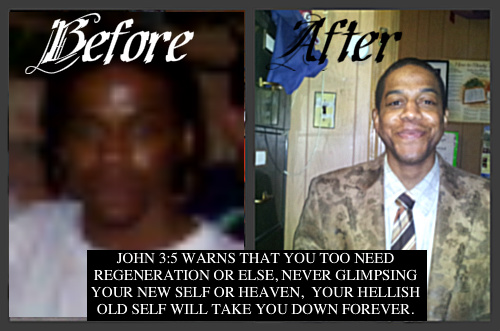
The before-and-after we can photograph: hitkhadshut — regeneration
We have no photograph of Yeshua on Friday or on Sunday. But the life that raised him is not only a future promise. Yochanan uses the present tense: whoever believes has eternal life. The resurrection life begins with the new birth, and sometimes you can see it on a face.
Placard
Before: a life in the criminal drug gangs. After: the same man, born again from above. What changed is not mainly his clothes or his surroundings; it is the person. “If anyone is in Moshiach, he is a new creation. The old has passed away; behold, the new has come.”
[Add his name and a sentence or two of his testimony in his own words, if he consents.]
ἔχειJohn 3:36 · 5:24 · 6:47
“has” — present: possessed now
“has” — present: possessed now
μεταβέβηκενJohn 5:24
“has passed over” — perfect: crossed and still across
“has passed over” — perfect: crossed and still across
ἀπελούσασθε1 Cor 6:11
“you were washed” — past: done
“you were washed” — past: done
Truly, truly, I say to you, unless one is born of water and the Ruach, he cannot enter the Malchus of G-d.
Yochanan 3:5
The verse on the photograph.
Whoever hears my word and believes him who sent me has eternal life. He does not come into judgment, but has passed from death to life.
Yochanan 5:24
From death to life — the same passage Yeshua made on the third day, made by the believer in this life.
Whoever believes in the Son has eternal life; whoever does not obey the Son shall not see life.
Yochanan 3:36
I am the Resurrection and the Life. Whoever believes in me, though he die, yet shall he live, and everyone who lives and believes in me shall never die.
Yochanan 11:25–26
G-d gave us eternal life, and this life is in his Son. Whoever has the Son has life… I write these things so that you may know that you have eternal life.
1 Yochanan 5:11–13
If anyone is in Moshiach, he is a new creation. The old has passed away; behold, the new has come.
2 Corinthians 5:17
Neither the sexually immoral, nor thieves, nor drunkards, nor swindlers will inherit the Malchus of G-d. And such were some of you. But you were washed, you were set apart, you were justified in the name of Adoneinu Yeshua HaMoshiach and by the Ruach of our G-d.
1 Corinthians 6:9–11
“Such were some of you” — Scripture’s own before-and-after caption.
He saved us, not because of works done in tzedakah, but according to his own rachamim, by the washing of regeneration and renewal of the Ruach HaKodesh.
Titus 3:5
Παλιγγενεσία — regeneration, rebirth: hitkhadshut.
You were dead in your trespasses and sins… but G-d, being rich in rachamim, made us alive together with Moshiach, raised us up with him, and seated us with him in the heavenly places.
Ephesians 2:1, 4–6
Raised and seated — past tense. The believer already shares the “after.”
He has delivered us from the domain of darkness and transferred us to the Malchus of his beloved Son.
Colossians 1:13
I will give you a new heart, and a new ruach I will put within you. I will remove the heart of stone from your flesh and give you a heart of flesh.
Yechezkel 36:26
We all, with unveiled face, beholding the glory of the Lord, are being transformed into the same image from glory to glory.
2 Corinthians 3:18
The transformation has already begun. Glorification finishes what regeneration starts.